
Impacts of Lifting Height on Lithium-ion Electric Forklift Selection
Core Logic
Mast lifting height causes effective load derating, shifts vehicle centre of gravity, reduces stability, and imposes higher requirements on hydraulic system, visibility and aisle space. Many buyers only focus on nominal tonnage while ignoring load reduction induced by high mast, which becomes a major hidden safety hazard.Principle: Higher lifting position raises cargo centre of gravity and increases overturning moment. Manufacturers define allowable effective load under different heights via load capacity chart. The higher the mast lifts, the lower the permissible load.
1. Lifting Height Triggers Effective Load Derating
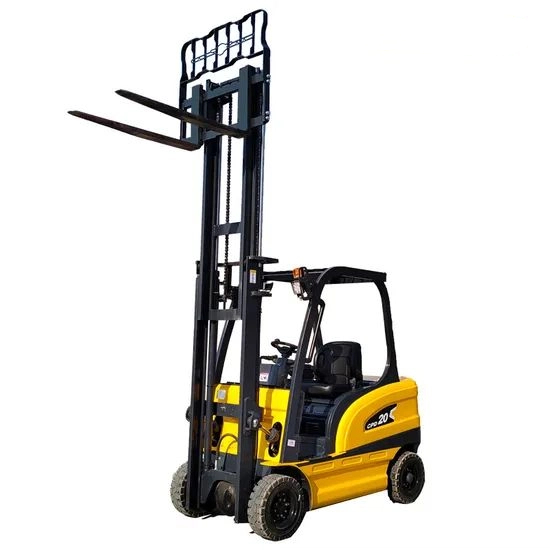
Taking a 3t counterbalance lithium forklift (500mm load centre, 3m two-stage mast) as reference: rated capacity reaches 3t.When fitted with a 4.5m three-stage mast, effective load declines; at 6m lifting height, allowable load may drop to 2.2~2.5t.Key Rules:- Do not select high-lift mast if cargo weight approaches the forklift nominal tonnage.
- Upgrade to higher tonnage model for mandatory high-lift operations to offset load derating.
- The allowable load shall be subject to the official load capacity chart instead of brochure nominal tonnage.
- Superposition effect: high lifting height + extended forks/attachments leads to double load reduction.
2. Lifting Height Determines Mast Type
- Lifting height ≤3.3m: Two-stage mastLow cost, excellent forward visibility, easy maintenance, suitable for regular stacking. Disadvantage: high collapsed height, not applicable inside containers.
- Lifting height 3.3m ~ 6m: Three-stage mastLow collapsed height, widely adopted for high-bay warehouses. Compromised visibility and obvious load derating.
- Operations inside containers/trucks: Full-free lift three-stage mastAllows fork lifting without extending the whole mast, higher procurement cost.Note: Ultra-high mast requires thickened profiles, reinforced chains and rollers to avoid deformation and shaking.
3. Requirements for Hydraulic System
High mast requires longer stroke and continuous oil supply. Frequent high-level lifting needs upgraded hydraulic pump to prevent slow lifting speed and jitter under high position. Continuous pressure increases wear of sealing components. Optimised hydraulic power output strategy is recommended for lithium forklifts.4. Vehicle Stability & Counterweight
When cargo is lifted high, centre of gravity rises significantly, reducing longitudinal and lateral stability. High-mast models need optimised counterweight design. Sharp turning and emergency braking are forbidden with elevated loads. Lightweight lithium forklifts with ultra-high masts have narrow stability margin; avoid continuous operation near maximum effective load.5. Site & Space Constraints
- Workshop clear height verification: Max lifting height + cargo height + safety clearance ≤ building clear height.
- Check aisle width for three-stage mast due to larger mast thickness.
- select full-free mast for low-headroom cold storage and enclosed spaces.
6. Visibility and Safety Accessories
Two-stage mast delivers best visibility; three-stage mast has obstructed view. For high-lift scenarios, optional accessories include side shifter, high-position camera, height limiter and load sensing system.7. Indirect Impacts on Three-Electric System
Continuous high-level lifting increases power consumption and shortens running time. For frequent high-lift & heavy-load cycles, reserve 10%~15% extra battery capacity to avoid BMS power limitation.Key Selection Risks to Avoid
- Calculate allowable load without considering lifting height, only refer to nominal tonnage, bringing overturning risks.
- Ignore mast collapsed height, resulting in failure to enter containers or trucks.
- Match high mast with standard hydraulic system, leading to insufficient lifting efficiency.
- Fail to reserve safety clearance for warehouse overhead space.
Summary
Lifting height is an essential parameter for lithium forklift selection:- Higher mast height reduces effective load. Verify permissible load via load curve; upgrade tonnage if high-lift operation is required.
- Confirm two-stage / three-stage / full-free mast based on lifting height and container operation demands.
- Adopt reinforced mast and upgraded hydraulic system for high-lift working conditions.
- Check building clear height and aisle width, and take high-position stability into consideration.
- Reserve extra battery capacity for frequent high-level lifting, and configure corresponding safety attachments.