
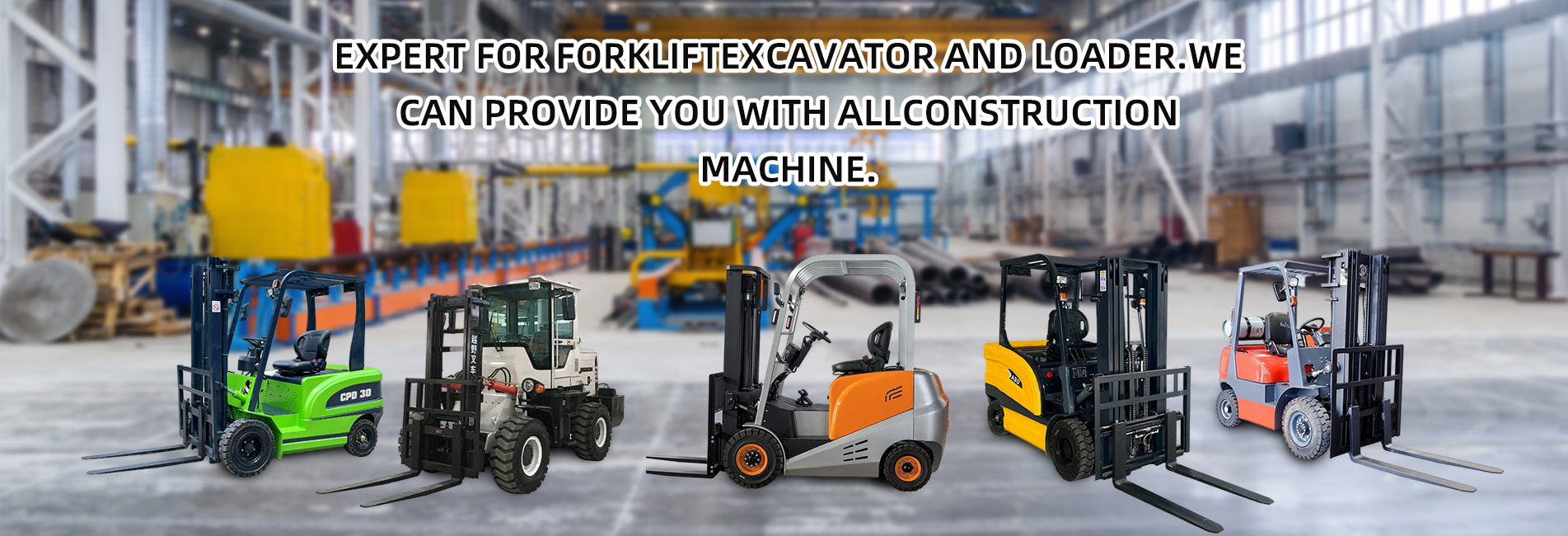
Forklift Operation Stability Assurance Scheme (Full-Process Standard Operation + Control System)
The core of forklift operation stability lies in center-of-gravity control, load matching, environment adaptation, standardized operation and closed-loop maintenance. It is necessary to establish a full-process control mechanism covering "pre-operation, in-operation and post-operation", along with supporting institutional and technical safeguard measures. The following is a professional and directly implementable scheme.
I. Pre-Operation Preparation (Source Prevention and Control, Elimination of Static Hidden Hazards)
Vehicle Condition Inspection (Mandatory Items, Establishment of Inspection Checklist)
| Inspection Items | Qualification Standards | Hidden Hazard Disposal |
Center of Gravity and Counterweight | Counterweights are firmly fixed without loosening; the battery power of electric forklifts (which also serve as counterweights) is sufficient; no counterweight loss or damage is allowed | Immediately stop using the forklift and replace or reinforce the counterweights |
| Tire System | Tire pressure complies with the manufacturer's specifications; tire treads are free from severe wear and cuts; bolts are tightly fastened; anti-skid/explosion-proof tires are adapted to working conditions | Adjust tire pressure and replace worn tires |
Braking and Steering Systems | No brake deviation, responsive braking performance; no steering jamming, normal steering clearance; steering angle meets the specified limit | Submit a maintenance request and strictly prohibit operation with faults |
Mast and Hydraulic System | The mast is free from deformation and weld cracks; the hydraulic system has no leakage; safety valves and limit switches are functional | Repair the leakage and calibrate the limit devices |
| Attachment Condition | Attachments such as side shifters and rotators are firmly fixed; their load capacity matches that of the forklift; no functional faults exist | Stop using the faulty attachments and recalculate the load capacity |
Load and Operation Plan Confirmation
- Verify the load weight, dimensions and center-of-gravity position, and strictly prohibit overloading. Loose or unstable loads (such as cartons and bagged goods) must be bundled and fixed; liquid loads shall be contained in anti-sloshing containers.
- Confirm the operation route: avoid potholes, slopes and oily/icy roads, and plan passages with sufficient turning radius. Heavy-load operation is prohibited on cross slopes; when operating on ramps, prioritize heavy-load ascending and no-load descending.
- Clarify the lifting height and mast tilt angle: for high-altitude operations (such as high-level shelf storage), reduce the load weight, tilt the mast backward as much as possible, and avoid forward-tilting operations.
Personnel and Protection Preparation
- Operators must hold valid certificates to take up posts and be familiar with vehicle performance and working condition risks. Overloading with personnel and carrying non-operational staff are strictly prohibited.
- Wear compliant protective equipment (including safety helmets and anti-skid shoes), set up operation warning zones, and prevent irrelevant personnel from entering.
II. Core Operation Specifications During Operation (Dynamic Control, Key Execution Links)
(1) Driving Operation (Control Speed and Center of Gravity, Prevent Side Slipping/Rollover)
- Load state: Retract the forks to 10-15 cm above the ground, tilt the mast backward to the limit position (to ensure load stability). It is strictly prohibited to lift/lower loads or tilt the mast forward during driving.
- Speed control: Maintain low speed when no-load; implement speed limits (≤5 km/h) for heavy-load operations, or when driving on slippery surfaces or in narrow passages. Reduce speed (≤3 km/h) when turning, and prohibit sharp turns and braking while steering.
- Ramp driving: When ascending a slope, drive forward at a constant speed and avoid gear shifting. When descending a slope, drive in reverse (with the load at the rear), gently step on the brake, and strictly prohibit coasting in neutral gear.
- Special road conditions: On icy/oily roads, activate the anti-skid mode (if available) and avoid emergency braking. On sandy/muddy ground, pass at a low and constant speed to prevent tire sinking.
(2) Loading and Unloading Operations (Control Load Center of Gravity, Prevent Longitudinal Rollover)
- Loading operation: Tilt the mast forward until the forks are fully inserted into the pallet, confirm that the forks are centered, tilt the mast backward to stabilize the load, then slowly lift the forks to avoid impact loads.
- Unloading operation: Slowly move to the shelf position, tilt the mast forward until the forks can be pulled out, confirm that the load is placed stably, then extract the forks. Violent pulling is strictly prohibited.
- Stacking/de-stacking: The higher the lifting height, the lower the operation speed should be. Lifting loads with the mast in a forward-tilted state is strictly prohibited; adjusting the mast tilt angle during high-altitude operations is forbidden.
(3) Enhanced Measures for Special Working Conditions
| Working Conditions | Core Measures |
| Narrow-Aisle Operation | select models with wide wheelbases/four-wheel steering; control the steering angle; prohibit spot turns; prioritize using side shifters for position adjustment |
| Low-Temperature Environment | Use low-temperature-resistant batteries/hydraulic oil; preheat the tires; avoid heavy-load ascending; reduce operation intensity |
| Explosion-Proof Scenarios | Activate the explosion-proof mode; strictly prohibit overspeed and sudden stops; regularly inspect explosion-proof components; ensure the load does not exceed the explosion-proof rated capacity |
| High-Altitude Operation (≥3m) | Adopt low-center-of-gravity models; reduce the load weight to below 50% of the rated load; lock the mast in the backward-tilted position; fix the operation radius |
III. Post-Operation Closure and Condition Maintenance (Closed-Loop Management, Avoid Hidden Hazard Accumulation)
- Vehicle Parking: Park in a flat, dry and slope-free area; engage the handbrake, lower the forks to the ground, tilt the mast backward and turn off the power. Parking on slopes, at passage entrances or in fire exits is strictly prohibited.
- Load Handover: Confirm that the load is placed stably without center-of-gravity deviation and properly labeled. Clean the operation area and eliminate hidden hazards such as oil stains and accumulated water.
- Vehicle Re-Inspection: Record abnormalities found during operation (such as weak braking and mast shaking) and submit maintenance requests in a timely manner. Replenish hydraulic oil and battery power to prepare for the next operation.
IV. Long-Term Assurance System (System + Technology + Training, Build a Solid Safety Defense Line)
- System Construction: Formulate the Regulations on Forklift Operation Stability Management, clarify load limits, speed standards and ramp operation prohibitions. Establish ledgers for inspection, maintenance and hidden hazard investigation, and conduct regular reviews.
- Technical Support: Install load sensors (for overload alarm), center-of-gravity monitoring systems and rollover protection devices (ROPS/FOPS). Equip electric forklifts with a Battery Management System (BMS) to ensure stable counterweight function.
- Training and Drills: Regularly carry out stability operation training (including special working conditions) and organize rollover emergency drills to improve operators' risk identification and disposal capabilities. Only those who pass the assessment are allowed to take up posts.
- Regular Maintenance: Implement the maintenance plan in accordance with the manufacturer's manual, focusing on inspecting core components such as tires, brakes, hydraulic systems, counterweights and masts. Increase maintenance frequency for special working conditions such as low-temperature and explosion-proof environments.
Supplementary: Stability Emergency Response (Emergency Situations, Reduce Losses)
- If rollover precursors occur (such as vehicle tilting and tire slipping), immediately stop operations, slowly lower the load, tilt the mast backward, and avoid sudden steering or emergency braking.
- In the event of a rollover, the operator should firmly grasp the steering wheel, move the body in the opposite direction of the vehicle's tilt, and evacuate only after the vehicle stabilizes. Jumping out of the vehicle is strictly prohibited.