
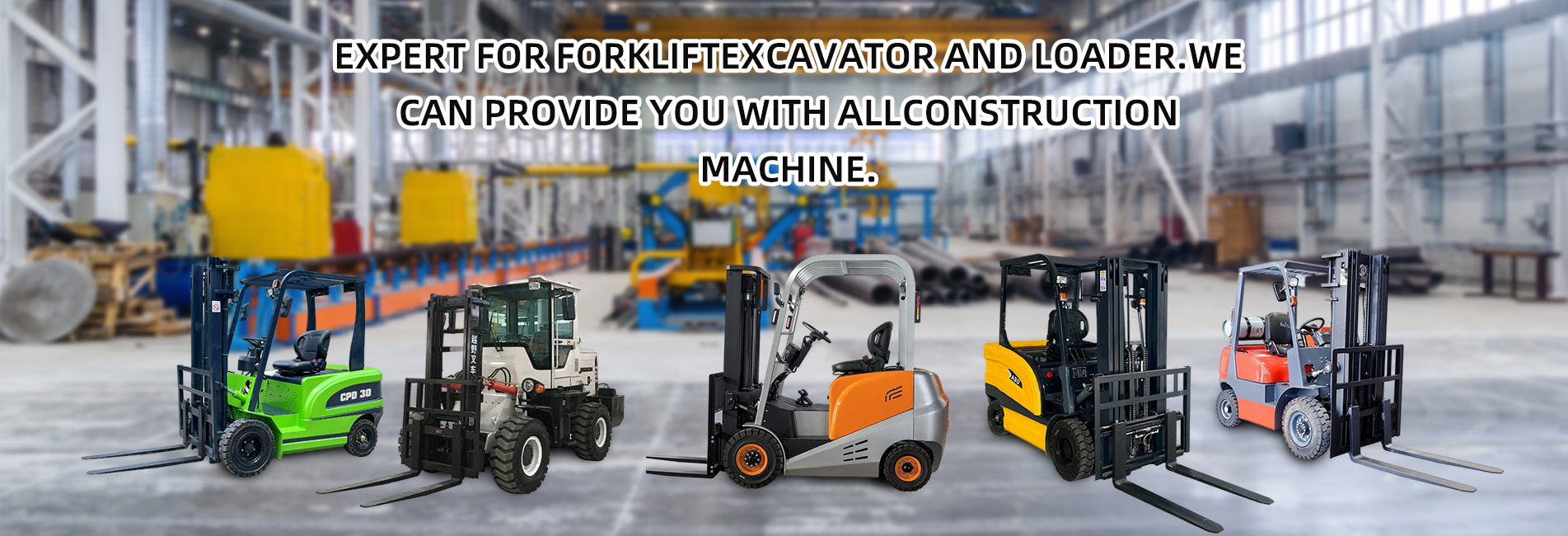
Safety Parameters and Technical Requirements of Forklifts
The safety parameters of forklifts are core technical indicators that ensure the compliant operation of equipment, the safety of operators, and the protection of goods and sites from damage. They cover four major categories: load-bearing capacity, stability, operation limits, and safety device configuration, with details as follows:
1. Safety Parameters Related to Load Capacity and Load Center
These parameters directly determine the safe operation range of forklifts. Operating beyond the specified range will trigger major risks such as tipping over and goods falling.
Rated Lifting Capacity
Definition: The maximum weight of goods that a forklift is allowed to lift under the standard load center distance (Unit: kg/t).Safety Requirements: Overloading is strictly prohibited; when the center of gravity of goods exceeds the load center distance, the lifting capacity must be reduced in accordance with the load curve.
Load Center Distance
Definition: The horizontal distance from the center of gravity of goods to the front surface of the vertical section of the forks (Unit: mm). Common standard values are 500 mm and 600 mm.Safety Requirements: For the same forklift, the larger the load center distance, the smaller the rated lifting capacity. The distance must be strictly matched with the dimensions of the goods.
Maximum Lifting Height
Definition: The maximum vertical height that the upper surface of the forks can reach when the forklift is carrying the rated load on a flat and firm ground (Unit: mm).Safety Requirements: The lifting height shall not exceed the value marked on the equipment; when operating at high altitudes, it is necessary to confirm the height of obstacles such as shelves and ceilings.
Free Lifting Height
Definition: The maximum height that the forks can rise without extending the mast outward (Unit: mm).Safety Requirements: It is suitable for operation in low spaces. Collision between the extended mast and the top structure must be avoided.
2. Safety Parameters Related to Stability and Structure
The stability of forklifts is the key to preventing tipping over, and the core parameters must comply with national standards (e.g., GB/T 5184-2023 Fork-lift Trucks - Stability Tests).
Loaded/Unloaded Stability
Definition: The ability of a forklift to resist longitudinal (front-rear) and lateral (left-right) tipping when in loaded/unloaded condition, usually measured by the stability angle or tipping critical value.Safety Requirements: All forklifts must pass stability tests before leaving the factory; during operation, sudden acceleration, sudden braking, sharp turns, and unilateral eccentric loading are strictly prohibited.
Minimum Turning Radius
Definition: The minimum radius of the turning trajectory circle of the outer or inner side of the forklift body when the forklift is traveling at low speed and the steering wheels are at the maximum deflection angle (Unit: mm).Safety Requirements: The turning radius determines the passability of the forklift in narrow passages. The width of the passage must be more than 1.2 times the turning radius.
Wheelbase and Track Width
- Wheelbase: The horizontal distance between the center lines of the front and rear axles.
- Track Width: The distance between the centers of the left and right wheels on the same axle (Unit: mm).Safety Requirements: The larger the wheelbase and track width, the better the stability of the forklift; forklifts with narrow track width must reduce the traveling speed to avoid side tipping.
Self-weight and Counterweight
Definition: The own weight of the forklift (including the battery/fuel tank) and the weight of the rear counterweight. The counterweight is used to balance the front load.Safety Requirements: Unauthorized removal of the counterweight is strictly prohibited; the stability of modified forklifts must be recalculated.
3. Safety Parameters Related to Operation and Operation Limits
These parameters regulate the traveling speed and operation boundaries of forklifts to prevent accidents caused by improper operation.
Maximum Traveling Speed
Definition: The maximum traveling speed of a forklift in loaded/unloaded condition on a flat and firm ground (Unit: km/h).Safety Requirements: The traveling speed in the factory area shall not exceed 5 km/h; the speed must be reduced to below 3 km/h when turning, driving on ramps, or in crowded areas with personnel.
Maximum Climbing Capacity
Definition: The maximum slope that a forklift can stably travel on in loaded/unloaded condition (Unit: % or °).Safety Requirements: When climbing uphill, tilt the forks forward and face the goods toward the top of the slope; when climbing downhill, tilt the forks backward and travel at low speed. Shifting gears or stopping on ramps is strictly prohibited.
Braking Distance
Definition: The traveling distance of a forklift from stepping on the brake pedal to a complete stop at the specified speed (Unit: m).Safety Requirements: The unloaded braking distance shall be ≤ 6 m (at a speed of 20 km/h); the braking system must be regularly inspected to ensure sensitivity and effectiveness.
Mast Tilt Angle
Definition: The forward and backward tilt angles of the mast relative to the vertical direction (Unit: °). The forward tilt angle is used for picking up goods, and the backward tilt angle is used for stabilizing goods.Safety Requirements: The forward tilt angle is generally 3°~6°, and the backward tilt angle is 10°~15°; adjusting the mast tilt angle during traveling is strictly prohibited.
4. Parameters Related to Safety Device Configuration
| Type of Safety Device | Configuration Requirements | Function Description |
| Safety Belt | Mandatory Configuration | Prevent operators from being thrown out in case of tipping |
| Overhead Guard | Mandatory Configuration | Protect operators from bein g hit by falling objects |
| Fork Carriage Backrest | Mandatory Configuration | Prevent goods from sliding backward and hitting operators |
| Braking System | Dual-circuit Braking (Preferred) | Ensure backup braking is available if one set of braking fails |
| Speed Limiter | Configurable as Required (Mandatory in Factory Areas) | Limit traveling speed and prevent overspeeding |
| Reverse Alarm | Mandatory Configuration | Emit sound and light alerts when reversing to remind surrounding personnel |
| Load Indicator | Recommended Configuration | Display load weight in real time to prevent overloading |
| Explosion-proof Device | Mandatory in Explosion-proof Areas | Suitable for flammable and explosive environments , must comply with explosion-proof grades |
5. Supplementary Safety Requirements
1.All safety parameters must be marked in prominent positions on the forklift body (e.g., rated lifting capacity, load center distance).
2.Electric forklifts must additionally meet battery safety parameters (e.g., charging temperature range, overcharge protection threshold).
3.Forklifts must pass regular third-party inspections to confirm that their safety parameters comply with national standards, and can only be used after passing the inspection.